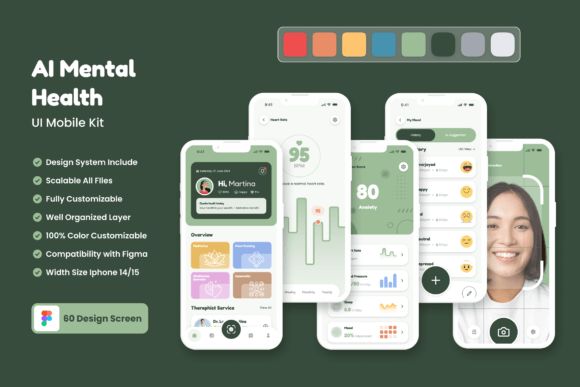
Ai Mental Health App Mobile UI KIT: Designing the Future of Digital Wellness
The intersection of artificial intelligence and mental health care is no longer a distant possibility—it is a rapidly expanding reality. As millions of people turn to mobile applications for support with stress, anxiety, sleep, and emotional regulation, the demand for well-designed, intuitive, and visually coherent tools has never been higher. Enter the Ai Mental Health App Mobile UI KIT, a collection of 20 high-quality, pixel-perfect screen templates that enable designers, developers, and entrepreneurs to build mobile applications for mental wellness with unprecedented speed and precision. This kit is more than a set of assets; it represents a shift in how digital wellness products are conceived, prototyped, and brought to market.
What Is the Ai Mental Health App Mobile UI KIT?
At its core, the Ai Mental Health App Mobile UI KIT is a comprehensive design system comprising 20 pre-built screen templates tailored specifically for mental health applications. Each screen has been crafted at pixel-perfect resolution, ensuring that every icon, button, typographic element, and layout aligns with modern mobile interface standards. The kit includes 80 distinct UI elements, 100 vector layers, and a free font, all organized in a fully layered structure. This means that whether you are a solo entrepreneur sketching out a concept or a seasoned product designer refining a clinical application, you have a ready-to-use foundation that can be customized in Adobe Photoshop, Adobe InDesign, or Sketch.
Beyond the raw count of templates and elements, what distinguishes this kit is its focus on the unique visual language of mental health apps. Soft color palettes, calming typography, intuitive navigation patterns, and clear data visualization for mood tracking or journaling are embedded in the design. The templates are not generic; they are context-aware, anticipating the specific user flows that mental health applications require—onboarding, check-in, progress tracking, community support, and crisis resource access.
The Broader Context: Why Mental Health Apps Demand Superior Design
The global mental health app market has experienced explosive growth, propelled by increased awareness, destigmatization, and the integration of AI-driven features such as chatbots, sentiment analysis, and personalized interventions. However, with growth comes competition. Users today expect more than functional software—they expect an experience that feels safe, trustworthy, and aesthetically resonant. A poorly designed interface in a mental health context is not merely a usability issue; it can undermine user confidence and even deter someone from seeking help.
This is where the Ai Mental Health App Mobile UI KIT finds its relevance. It addresses a critical gap in the market: the need for design assets that are both high-quality and thematically appropriate. Many UI kits are either too generic to convey the sensitivity required for mental health or too niche to be adaptable. This kit strikes a balance, offering templates that are industry-specific yet flexible enough to accommodate different therapeutic models, branding strategies, and feature sets.
Industry Trends Driving Adoption
Several concurrent trends make this UI kit particularly timely. First, the rise of AI-assisted therapy has introduced new interface patterns—conversational agents, emotion recognition dashboards, and adaptive content delivery—that require thoughtful design. The kit includes vector layers and symbol objects that can be modified to represent AI interactions without starting from scratch. Second, the demand for data privacy and transparency in mental health apps has led to more detailed consent and settings screens, which the kit provides as part of its 20 template set. Third, the shift toward holistic wellness—where mental health apps integrate with fitness, nutrition, and sleep tracking—means that designers need modular components that can be recombined. The 100 scalable vectors and 80 UI elements in this kit make such recombination practical.
Why People Are Paying Attention to This UI Kit
Entrepreneurs, marketers, freelancers, and creative professionals are gravitating toward the Ai Mental Health App Mobile UI KIT for reasons that go beyond its technical specifications. One of the most compelling advantages is the reduction in time-to-market. Building a mobile application from scratch involves countless iterations of wireframing, prototyping, and visual design. With a kit that offers 20 ready-made screens, much of the foundational work is already complete. This allows teams to focus on the elements that truly differentiate their product—such as proprietary AI algorithms, unique content libraries, or specialized clinical partnerships.
Another reason for the kit's appeal is its cross-platform adaptability. Because the templates are designed in industry-standard tools (Adobe XD, Photoshop, and Sketch), they can be exported to multiple formats and integrated into different development workflows. For freelancers juggling multiple client projects or agencies scaling their output, this flexibility is invaluable. The inclusion of free icons, vector layers, and editable color styles means that rebranding or theme-switching can be accomplished in minutes rather than days.
Changing Workflows and Expectations in Mobile App Design
The way designers and developers approach mobile app creation has evolved significantly in recent years. Agile methodologies, rapid prototyping, and user-centered design are now standard. Yet, the production of high-fidelity mockups remains a bottleneck. The Ai Mental Health App Mobile UI KIT aligns with modern workflows by offering assets that are fully layered and symbol-based. This means that changes made to one symbol propagate across all instances, reducing repetitive work and minimizing the risk of inconsistencies.
For entrepreneurs and marketers who may not have deep design expertise, the kit democratizes access to professional-grade visuals. Instead of hiring a full-time designer to produce every screen, a founder can start with the kit, customize it using the intuitive tools in Sketch or Photoshop, and produce a prototype that is ready for user testing or investor pitches. This shift—from design as a specialized bottleneck to design as an accessible resource—is one of the most significant changes in the creative economy, and UI kits like this one are at the forefront.
Practical Examples of Use Cases
Consider a mental health startup building an app that pairs users with AI-driven cognitive behavioral therapy (CBT) exercises. Using the kit, the team can quickly prototype the onboarding flow, the daily mood check-in, the therapy session interface, and the progress dashboard. The 100 vector layers allow them to illustrate concepts such as "thought reframing" or "emotion mapping" without needing custom illustrations. Meanwhile, the free font included in the kit ensures typographic consistency from the first prototype to the final product.
In another scenario, a freelance designer is hired to refresh the interface of an existing meditation app. Instead of redesigning every screen from scratch, they can select relevant templates from the kit—such as the session timer, guided meditation player, and community feed—and adapt them to the client's brand guidelines. The ability to change color styles easily, thanks to the kit's layered structure, means that a new palette can be applied across all screens in a fraction of the time it would take to rebuild each element manually.
Connecting to Larger Developments in Digital Health
The Ai Mental Health App Mobile UI KIT does not exist in a vacuum. It is part of a broader ecosystem where digital tools are increasingly seen as legitimate complements to traditional mental health care. Regulatory bodies, insurance providers, and healthcare systems are beginning to recognize the role of well-designed apps in improving patient outcomes. As this recognition grows, the visual and functional quality of these applications will come under greater scrutiny. Apps that appear hastily constructed or visually disjointed may struggle to gain the trust of both users and clinical partners.
Furthermore, the kit's emphasis on vector-based, scalable assets reflects a larger industry movement toward design systems that are responsive and adaptive. With users accessing mental health tools across phones, tablets, and even wearable devices, the need for interfaces that scale gracefully is paramount. The 100 scalable vectors in this kit are not just decorative; they are functional components that can be resized and repositioned to suit different screen dimensions without loss of clarity.
Observations on the Creative and Commercial Landscape
From a commercial perspective, the availability of a specialized UI kit like this one signals a maturation of the digital mental health market. Early entrants often had to design everything from scratch because no relevant templates existed. Now, the presence of a dedicated kit indicates that the market has enough demand, diversity, and sophistication to warrant specialized design resources. For marketers, this is a signal that the category is becoming mainstream enough to support standardized tools, which in turn makes it easier to launch and scale products.
For creators and enthusiasts, the kit offers a hands-on way to explore the visual language of mental health technology without committing months to design education. By studying the templates, one can learn about layout patterns, color psychology, and user flow conventions that are specific to wellness applications. This educational dimension is often overlooked but is one of the most valuable aspects of a well-constructed UI kit.
Customization and Creative Control
One of the most frequently cited advantages of the Ai Mental Health App Mobile UI KIT is its editability. The phrase "fully editable" can sometimes be misleading in the design asset world, but in this case, it is a core feature. Every layer, symbol, and vector can be modified. If a designer wants to add an additional step to the onboarding flow, they can duplicate a screen and adjust the elements. If a marketer wants to test a different call-to-action placement, they can rearrange components without breaking the overall layout. The kit is built to encourage iteration, not to constrain it.
The inclusion of 80 UI elements—ranging from buttons and toggles to cards and navigation bars—means that even after using the 20 pre-built screens, you have a library of components to construct new screens as your app evolves. This is particularly important for mental health applications, which often require custom features such as emergency contact buttons, privacy toggles, or mood sliders. The kit provides these elements in a consistent visual style, ensuring that the app remains cohesive even as it grows in complexity.
A Note on the Preview Images
It is worth clarifying that the images used in previews of the Ai Mental Health App Mobile UI KIT are for demonstration purposes only and are not included in the download files. This is standard practice in the design asset industry, but it is important for users to understand that the kit provides the templates, layers, vectors, and icons—not stock photography. This distinction actually works in favor of customization: you are free to use your own imagery, client-provided photos, or AI-generated visuals without being tied to someone else's choices. The kit gives you the structure; you supply the context.
Final Thoughts
The Ai Mental Health App Mobile UI KIT is more than a collection of templates. It is a response to the growing need for thoughtfully designed digital tools in a domain that affects human well-being. For professionals, entrepreneurs, marketers, freelancers, and enthusiasts, it offers a practical, time-saving, and creatively flexible foundation for building mobile applications that are both functional and emotionally resonant. As the mental health app ecosystem continues to expand and mature, resources like this kit will become not just convenient, but essential for those who want to compete on quality, speed, and user experience.
Whether you are prototyping a new concept, refining an existing product, or exploring the intersection of AI and wellness, the kit provides a starting point that respects your time, your budget, and your creative vision. The 20 pixel-perfect screens, 80 UI elements, 100 vector layers, and symbol-based architecture are all designed with one goal in mind: to help you build a better mental health application, faster.